United Way of Dane County Celebrates the 2025 Community Campaign
United Way’s Community Campaign, strengthened by donors and the Dan & Patti Rashke (TASC) Family Foundation commitment, is on track to reach its $17.5 million goal.
Download PDF here
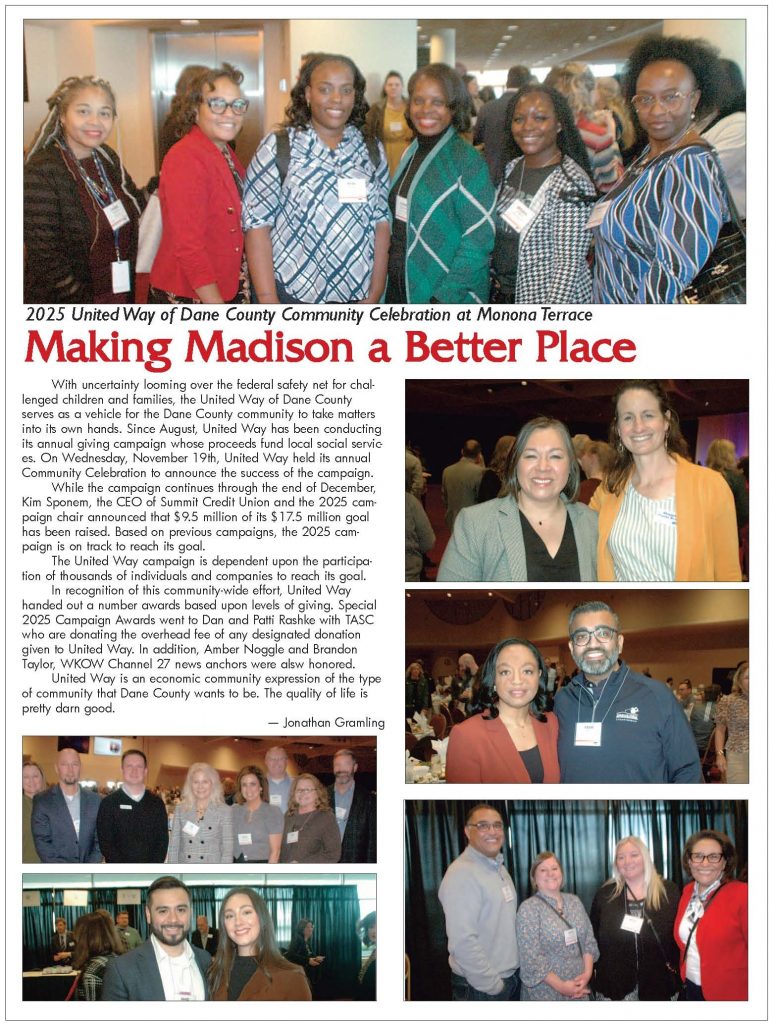
Madison, WI (November 20, 2025) – United Way of Dane County celebrated the community’s generosity at the 2025 Community Celebration held Wednesday at Monona Terrace. More than 550 community members, representing businesses, nonprofits, volunteers and donors from across Dane County, gathered to honor the efforts of more than 13,000 individual donors and nearly 500 workplace partners.
This year’s campaign was energized by a historic 10-year, $10–$15 million commitment from the Dan & Patti Rashke (TASC) Family Foundation — the largest multi-year philanthropic commitment in United Way of Dane County’s history. The gift ensures that 100% of undesignated individual donations directly address the greatest needs in the community in the areas of youth opportunity, financial security, healthy community and community resilience.
“This celebration is our chance to pause and recognize all the people, partners and businesses who care deeply about this community — and to thank them for the good they make possible,” said Renee Moe, President & CEO of United Way of Dane County.
This focus on community support comes during a year of significant nonprofit funding changes. When FoodShare benefits were delayed nationwide earlier this month, roughly 65,000 Dane County residents faced immediate food insecurity, and calls to United Way 211 surged by 147%.
“Even as demand for services increases and changes, Dane County continues to demonstrate extraordinary caring, innovation and resilience,” Moe said. “I see people stepping up. Businesses rallying behind their employees and their community involvement. Volunteers giving their time. Donors giving according to their means. That’s who we are. That’s what it means to be united in community.”
Thanks to the leadership of Kim Sponem, President and CEO of Summit Credit Union and 2025 Campaign Chair, along with the dedication of United Way’s volunteers and donors, $9.5 million has been raised toward the $17.5 million campaign goal. The campaign remains on track to achieve its goal, as workplace campaigns and individual end-of-year giving continue throughout the year.
“Over the past year as the 2025 Campaign Chair, I’ve heard many people’s stories about why they give to United Way,” Sponem said. “Within these stories is an underlying fact, life is hard in a lot of ways for a lot of people. We don’t always know what our neighbors are going through.”
Sponem shared the powerful story of a mother and seven-year-old daughter living in their car, struggling to maintain stability while ensuring the child gets to school each day — a reality for too many local families. “7.4% of children in Dane County are living in poverty, and more than 2,200 kids are homeless,” Sponem said. “Together with United Way, we can prevent homelessness and its negative ripple effects. We want to spread the message that everyone has the power to create change and that United Way is a pathway to making a lasting impact. Thanks to United Way’s effective community mobilization, every dollar you give is multiplied sixfold to maximize positive change. We encourage you to continue giving, and to invite others to join you, so our collective efforts can transform Dane County.”
The celebration recognized the vital contributions of nonprofit agency partners, workplace campaign partners, volunteers, donors and sponsors.
“Our agency partners are the heartbeat of this work, transforming dollars into impact, programs into hope and ideas into change,” Moe said. Our workplace campaign partners build cultures of giving and leadership that ripple far beyond workplace walls,” Renee said. ”As we look ahead, we know the road will continue to twist and turn. But what gives me hope is that we are not walking alone – we’re walking together — as partners, as neighbors, as a community that refuses to give up on one another. We’ll keep working side by side to build a Dane County where every child, every family, every individual has the opportunity to thrive.”
The campaign continues through December 31. Community members interested in supporting United Way of Dane County or increasing their pledge to maximize tax benefits can visit unitedwaydanecounty.org.
United Way of Dane County is grateful to all who were able and willing to donate their time and dollars in 2025. Your gift, no matter the size, builds a future where everyone can thrive.
Companies who contributed to the United Way Community Campaign through corporate gifts, employee giving and special events:
$1,000,000+
American Family Insurance
$500,000+
Henry J. Predolin Foundation, Inc.
Partners in Giving: State of Wisconsin, UW-Madison and UW Health Employee Combined Campaign
Roots & Wings Foundation
TruStage
$250,000+
Baker Tilly Advisory Group, LP
Christensen Associates
Exact Sciences
J.H. Findorff & Son Inc.
Madison Gas and Electric
Sub-Zero Group Inc.
UW Credit Union
Zimbrick, Inc.
$100,000+
Alliant Energy
Bankers’ Bank
BMO
First Business Bank
Hooper Corporation
Hy Cite Enterprises, LLC
M3 Insurance
National Guardian Life Insurance Company
Siemer Institute for Family Stability
Summit Credit Union
TASC
Vogel Bros. Building Co.
West Bend Insurance Company
WPS
2025 Community Celebration Sponsors:
Presenting Sponsor: American Family Insurance; Community Sponsors: Summit Credit Union, Alliant Energy, Madison Gas and Electric and UW Credit Union; Partner Sponsors: BMO, J.H. Findorff & Son Inc., Hiebing; Media Sponsors, WKOW; and Table Sponsors: Ascendium Education Group, Cummins, First Business Bank, IFF, McClone Insurance, National Guardian Life Insurance Company, TruStage.
Campaign Partner Sponsor:
A donation from longtime supporters Dan and Patti Rashke and their Dan & Patti Rashke (TASC) Family Foundation acts as a powerful catalyst – amplifying the impact of your generosity. Every penny of your individual and undesignated gift goes directly toward resolving the greatest needs in our community – a rare and remarkable advantage that few organizations can offer.
A full list of award recipients, honorable mentions, additional volunteer recognitions and sponsors, is included in the 2025 Community Celebration Program:
Accelerating Impact Award: Hooper Corporation, TruStage, Vogel Bros. Building Co., Benjamin F. Edwards & Co., Catalent, Thermo Fisher Scientific, Inc. Recognizing companies who have grown their financial impact over the last three years the largest (% increase in dollars), helping to accelerate positive change in our community.
The Power of Many Award: Bergstrom Automotive, Buttonwood Partners, MIG Commercial Real Estate. Recognizing companies who are engaging more people in supporting our community through workplace campaign best and growing employee participation.
Innovation Award: Godfrey & Kahn, SC, Truity Partners, LLC. Recognizing companies who are committed to raising awareness and resources through new and creative strategies.
Advocate in Action Award: Access Community Health Centers Staff; Raj Ravi, Hooper Corporation and Maggie Waid, RISE Wisconsin, Inc. Recognizing campaign volunteers who are passionate about giving back, enthusiastic about engaging others in learning about our community and inspiring everyone to give, advocate and volunteer.
Collaboration Award: UW Health and Quartz for HealthConnect. United Way partners who serve our community and facilitate collaborative action leading to meaningful change. This year recognizing the impact of the HealthConnect health insurance premium assistance program.
Leading the Way Award: M3 Insurance, Summit Credit Union. Recognizing corporate partners who create opportunities for employees to lead through their philanthropy with United Way’s donor networks (Tocqueville Society, Lead United, Women United and LINC for Young Professionals).
To learn more, visit www.unitedwaydanecounty.org. For media inquiries and interview requests, please contact Adrienne Kramer, Program Manager, Communications and Digital Media, United Way of Dane County at Adrienne.kramer@uwdc.org or (608) 504-6137.
# # #
About United Way of Dane County:
United Way of Dane County mobilizes the caring power of our community so all can thrive. From advancing health and education to strengthening livelihoods and local resilience, we connect people to possibility. With a mission to unite the community to achieve measurable results that change lives, we work collaboratively with local nonprofits, businesses, community leaders, donors and volunteers to multiply impact and solve big-picture issues no one person or organization can address alone. United Way holds ourselves and our partners accountable for effective use of resources and measurable results. Together, we are The Power of Caring. Working for All. Visit www.unitedwaydanecounty.org to learn more.